Tuesday, December 11, 2018

Review: Peak Performance: Elevate Your Game, Avoid Burnout, and Thrive with the New Science of Success

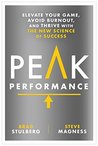
Peak Performance: Elevate Your Game, Avoid Burnout, and Thrive with the New Science of Success Peak Performance: Elevate Your Game, Avoid Burnout, and Thrive with the New Science of Success by Brad Stulberg
My rating: 5 of 5 stars

This book falls into one of my favorite genres, which is best described as how to be the best you can be. Peak Performance is authored by two guys, Brad and Steve, each of whom peaked rather dramatically (in business and in sports, respectively) but burned out. They met, shared beers and bios, and teamed up to write about a topic they both love – the science of performance.

What this book offers, which many others of this type do not, is pace and balance. It has the perfect combination of anecdote and science. The authors found the optimum time and space to devote to each topic. And the delivery is downright neighborly without sacrificing any of the heft one seeks in a book on best practices in productivity.

They refer to some of my very favorite authors/researchers and that made me smile: Mihaly Csikszentmihalyi, Roy Baumeister, Kelly McGonigal, Adam Grant, Daniel Kahneman, Mason Curry, Walter Mischel, Tim Noakes, Daniel Pink, Viktor Frankl …. and many, many more.

Topics discussed included the importance of balancing rest with stress for success, establishing routines for minimizing decision fatigue, failing productively (struggles give birth to skills!), and becoming a minimalist in order to get the most bang for your attention-buck. Each chapter is summarized at the end, which is not a huge thing, but I found it useful, I did.

Peak Performance is a nifty distillation of the best current human performance science in both physical and cognitive realms and I enjoyed it from start to finish. You will be reminded about your potential, and you when you finish it, you will have more resolve to chip away at the nonsense and time-wasters which keep you from meeting your goals. You will feel ready for change.


View all my reviews

Friday, December 7, 2018

Review: The Woodlanders

The Woodlanders The Woodlanders by Thomas Hardy
My rating: 4 of 5 stars

The late 19th Century teemed with Hardy’s words. He wrote heaps and it is all good. This book, The Woodlanders, was his own personal favorite.

Set in an isolated, slightly backward village known as Little Hintock, it tells the story of a bright young woman and her always "too little, too late love life", which seemed destined for tragedy due to a serious problem with timing.

This quote really sums up the infernal, ever-present puzzle in this book: “Such miserable creatures of circumstance are we all.”

Grace Melbury is the objet de désir throughout. She was sent away to boarding school because her father wanted her to rise above her circumstances. He did not want her to be a commoner, he wanted her to advance beyond the culture of their little village. She returns bright, refined, and cultured. Now, she is caught between two worlds. She loves a commoner as well as a promising, well-educated doctor (or at least she thinks she does).

Grace is a principled young woman who has great difficulty resolving the unprincipled forces in her life, constrained as she is by the intractable subjugations of women at the time. In other words, she is not really free to fix this up to her own satisfaction. Add to this general problem of emotional bondage, the interference from the world outside of Little Hintock and interference from her meddlesome father (whom she is absolutely bound to obey) and you have a perfect storm for the tragedy of unintended consequences.

Some of the players: Giles (the commoner/a woodlander) was a breath of fresh air but extremely dense at times. Edred (an outsider/doctor) needs very much to get over himself. Marty (a poor woodlander girl) made me smile; she was pure strength.

I love Hardy but I was grateful that this story was not as solidly tragic as Tess of the d’Urbervilles. I did find the plain satisfaction I typically seek at the end of a major work, but not until the end.


View all my reviews

Tuesday, December 4, 2018

Review: Bruno's Dream

Bruno's Dream Bruno's Dream by Iris Murdoch
My rating: 4 of 5 stars

As gold is to the Midas-touch, so words are to the Murdoch-touch. This writer rounds up words so keenly - beautiful constructions do result. After finishing The Sea, The Sea last month, I officially began my Murdoch bender, and, oh, it isn’t over yet. I have just acquired The Philosopher’s Pupil, but first things first. Here are my impressions of Bruno’s Dream.

The notion of a dying old man who hopes to find closure and understanding with his only living child, was deeply appealing to me. But, this old man is a scabrous thing, unlikeable and needy. Apart from his clumsy and impatient attempts to mend bridges, paucity of merit alone marks his character, and, somehow, whatever ails him (other than old age) has deformed him horribly.

The cutlery of Murdoch’s character development is devilishly good. There is no one we dearly love and no one we actually hate. There is a ball and chain fastened securely to the heart of each character. Baggage they have each lugged through life. Then, through Bruno's wish to make amends, crazy stuff begins to happen. They each go through a personal crisis which loosens each ball and chain. They change.

We can identify with each of these characters, just a little, which is what casts the spell so well. Ok, the creepy, elfin-like and puzzling Nigel is an exception. I did not like him and can’t imagine anyone who would.

It is possible that there are too many characters. It is also possible that the zany channeling of Twelfth Night-like switcheroos gets tiresome. But, with quotes like this peppering each page, I can overlook those teensy aggravations:

“Brooding about the past is so often about how one might have won and resentment that one didn’t. It is that resentment which one so often mistakes for repentance.”

You will be moved by this book.


View all my reviews

Friday, November 23, 2018

Review: The Sea, the Sea

The Sea, the Sea The Sea, the Sea by Iris Murdoch
My rating: 5 of 5 stars

What a miraculous book. I have only just now finished it, and I already know that I will begin the re-reading of it tonight. I cannot wait. Without a doubt, it is on that shelf of one of the very best.

You are wondering what it is about? Heavy sigh. It is about everything, of course, as the greatest books are. But, Murdoch focuses with frightening clarity on marriages, relationships, lost love, delusions, the darkness we hide from, and the darkness we hide away.

It is a stormy, psychological journey into the hearts of many different characters whose paths are all intertwined. It begins with a famous actor/director (Charles Arrowby) retiring to a little run-down house by the sea where he swims, cooks wonderful meals, collects rocks, thinks, and writes about his life. Lord, it sounded like heaven to me. Of course, it was not.

There are tiny little shadows cast upon the reader from the start, and we slowly grow uneasy with the knowledge that so much is hooded, masked, and cloaked in falseness and danger, but we cannot quite put our finger on what it is. The zig-zagging trajectory of the tangled lives cannot be forecasted by the reader.  Although we long for a predictable outcome to so many of the extraordinary events, this is not what we get. Murdoch is a realist. She puts a little dash of beast in everyone and the effect is a gentle bludgeoning which (sickeningly) we do understand, and from which (appallingly) we cannot tear our eyes away.

I felt slightly shackled to this story. Even when I took a break from the reading, her words followed me. Everywhere. It is haunting. It is very powerful. Murdoch was an amazing talent.  How many authors can conjure the perfect words to describe "eyes that are determined to lose hope"? She does this and other breathtaking word-feats.   Aren't you curious? 

View all my reviews

Sunday, November 11, 2018

Review: How to Bake Pi: An Edible Exploration of the Mathematics of Mathematics

How to Bake Pi: An Edible Exploration of the Mathematics of Mathematics How to Bake Pi: An Edible Exploration of the Mathematics of Mathematics by Eugenia Cheng
My rating: 4 of 5 stars

This is a real charmer for the mathanxious among us. How to Bake Pi is a one-of-a-kind book about the mathematics of mathematics in which each chapter begins with a familiar recipe. The author, Eugenia Cheng, is a (math) category theorist, among other things. Her goal in this book is to first illustrate some of the useful tools of math but, then,  to ultimately have the reader understand the common thread of relationships, languages, shapes, and ideas to which math can play host. The recipes featured help her reveal the general principle in each chapter. Mercifully and skillfully, she refers back to components of the recipe to make sure she hasn’t lost her reader as she marches forward with her brave analogies.

Here's how I like to think about category theory. It's the Magna Mater Franchisor. From it spring multiple different franchises, different shapes and sizes and products, but with recognizable components and packaging. It works for me but I can't promise its accuracy, coming from me, a mathanxious one.

My favorite thing about this book? The word axiomatization - I can’t wait to use it. It is the reduction of some complex system to a simpler set of rules. Who cares, you say? I do and you should too. Think about any huge problem you have in your life – something complicated with dozens of ramifications. Make a short list of the good and the bad. Axioms will materialize from this – themes which will both illuminate and provide direction.

I am more curious than ever about category theory and also about Eugenia Cheng. She has authored two additional books since How to Bake Pi and I have ordered them both. Stay tuned for more reviews of Eugenia Cheng’s work!


View all my reviews

Wednesday, November 7, 2018

Review: Tess of the D'Urbervilles

Tess of the D'Urbervilles Tess of the D'Urbervilles by Thomas Hardy
My rating: 4 of 5 stars

Suffering. Heartbreak. Injustice. Good grief. Never have I been so glad to enter this world in the 20th Century (and not sooner)! But, poor, poor Tess D’Urberville. Her extremes of mortification and deprivation, which rake at her relentlessly and which spring from those villainous Victorian affectations – well, it bordered on the oppressive, it truly did. Has anyone ever been as unlucky as Tess D’Urberville?

Only the majestic parade of elaborate, spotless sentences kept me reading. Thomas Hardy did not just write. He ennobled his reader with word monuments - chapter after celestial chapter, lines and lines of magnificently turned-out sentences.

Throughout the story, dread is ever-present, lurking in every small turn of events, and we know, we just know, as we read on, that there will be, there must be, a limit to Tess’s forbearance. Hardy seems to luxuriate in the misery and inequity. Readers are made uncomfortable by Tess’s torments. Of course, this is no accident. His message on the abuses of the era is loud and clear.

My mind has been steeped in such bounty of lovely language, that I can’t resent Hardy for dispatching so many hours of doom and gloom. It is a very BIG story and a great one, too, although you might need to medicate with some chocolate when done.


View all my reviews

Tuesday, November 6, 2018

Review: The Disappearing Spoon: And Other True Tales of Madness, Love, and the History of the World from the Periodic Table of the Elements

The Disappearing Spoon: And Other True Tales of Madness, Love, and the History of the World from the Periodic Table of the Elements The Disappearing Spoon: And Other True Tales of Madness, Love, and the History of the World from the Periodic Table of the Elements by Sam Kean
My rating: 5 of 5 stars

A book on the periodic table is a highly improbable selection – for me, at least. But, truly it has colored and brightened the topic so pleasantly that I cannot recommend The Disappearing Spoon by Sam Kean too much. After designing a chemistry curriculum for my fourth and final home educated kiddo, I thought this book would serve as a nice compliment to the more tedious tasks of balancing chemical equations and fiddling with bunsen burners. We read it together.

We were so entertained by some of the sidekick info offered by Mr. Kean, that even though it was sometimes hard to parse the content, we looked forward it cheerfully. Never did I think that acquiring literacy in the fundamentals of chemistry would be something to put a spring in my step. The 15 year old found my wonderment, as Kean worked his magic with artful anecdotes, a little….inconvenient, shall we say? (Generational divergences, I guess.)

This book is great. For example, did you know that every amino acid in every protein in your body has a left-handed twist to it? We have Pasteur to thank for this piece of knowledge, which is expanded upon to reveal how some compounds twist light and how life as we know it has a strong bias for only one “handedness” and how if we find microbes on another planet to be right-handed, we know it is from an alien. How cool is that?

On the poisoner’s dark arts, Kean notes: “Scarily, cadmium is not even the worst poison among the elements. It sits above mercury, a neurotoxin. And to the right of mercury sit the most horrific mug shots on the periodic table—thallium, lead, and polonium—the nucleus of poisoner’s corridor.”

On why and how lithium works in the brains of manic-depressives, Kean explains: “Lithium regulates the proteins that control the body’s inner clock. This clock runs, oddly, on DNA, inside special neurons deep in the brain. Special proteins attach to people’s DNA each morning, and after a fixed time they degrade and fall off. Sunlight resets the proteins over and over, so they hold on much longer. In fact, the proteins fall off only after darkness falls—at which point the brain should “notice” the bare DNA and stop producing stimulants. This process goes awry in manic-depressives because the proteins, despite the lack of sunlight, remain bound fast to their DNA. Their brains don’t realize they should stop revving.”

And some of the fun-to-know stuff Kean reveals: “Einstein came to distrust quantum mechanics. Its statistical and deeply probabilistic nature sounded too much like gambling to him, and it prompted him to object that ‘God does not play dice with the universe.’ He was wrong, and it’s too bad that most people have never heard the rejoinder by Niels Bohr: "Einstein! Stop telling God what to do.”

Visiting Kean’s website, I discovered that he has other books like this one and we will start The Violinist’s Thumb in a few weeks!

Kean takes topics that mere mortals (like me) find dull and dusty and somehow makes them bright and shiny. Oh, bless this man.


View all my reviews