Friday, January 11, 2019

Review: The Death of Expertise: The Campaign Against Established Knowledge and Why It Matters

The Death of Expertise: The Campaign Against Established Knowledge and Why It Matters The Death of Expertise: The Campaign Against Established Knowledge and Why It Matters by Tom Nichols
My rating: 4 of 5 stars

Ignorance often plays host to intolerance and they can sit together at a granite bar with a fine Merlot just as easily as they can motor down the aisles of Walmart. I think Mr. Nichols would agree with this. My uncertainty here stems from the inherent problem of an intellectual successfully writing on the dangers of anti-intellectualism. It stirs mistrust. I struggled with skepticism, I confess, but his delivery is even-handed and (dare I say it?)….knowledgeable.

Mr. Nichols gets major points for bravery, as writing a book about the dangers of ignorance is a thankless enterprise. Experts of every kind (self-professed and world renowned) are fist-pumping while the wannabes and ordinary folk might feel slightly provoked.

Medicine, engineering, science, education, construction, law, technology, …. all of these disciplines and many more are populated with trained individuals who are daily challenged by dunderheads equipped with little more than google links wanting to dismiss hard-won expertise. The Death of Expertise speaks directly to these much-abused experts.

Nichols walks the reader through all of the digital-age malefactors and makes several good points about the challenges to expertise arising from the fact that there is just too, too much information out there. All of the culprits are addressed: confirmation bias, entertainment bubbles, erroneous polls and market research, very significant mistakes experts have made in the past, and the unshakeable belief many people now hold - that their own guesses are as good as the expert’s guesses.

I devoured this book, but a few questions nagged me.

In our ideologically bifurcated culture – supported by our beloved technologies – aren’t all of our new experts and future experts thoroughly drenched in some bias, some world view, some bubble-driven philosophy? Or have they acquired a super-human power enabling them, as they studied and worked, to embrace objectivity all throughout? Do they graduate from Brown, intern at Alphabet, and shuffle around at WeWork with their Shih Tzu while maintaining a healthy respect for the non-organic farmer from Topeka? Or is the non-organic farmer from Topeka not “a real expert” to be respected?

Also, if a hypothetical Mr. Smith has witnessed the experts getting it wrong (via wars, medicines, chemicals, investments, and, yes, technology) and if these mistakes-of-expertise seriously derailed Mr. Smith’s life … then how, oh how, does this mere mortal separate his sad, expertise-driven setbacks from a permanent, enervating cynicism?

I do not think that one person’s ignorance is better than another person’s knowledge and share the same goals as Mr. Nichols: a vibrant intellectual and scientific culture and in which its citizens trust its leaders and policymakers. Truly, how can we move forward without this?

My favorite section of the book was on Repairing the Relationship. I wish half the book had been devoted to this as most are aware of how serious the problem is, but few know how to fix it.

The resentment of experts by laypeople is institutionalized. And the resentment of laypeople by experts has grown exponentially since Donald Trump was elected president. So, can mutual resentment be remediated with mutual respect, without exacting a pound of flesh from each? And, if so, how?

The headwaters from which all rejection of expertise springs can possibly be found in our culture’s loathing of the mere prospect of right vs. wrong, good vs. bad. For decades we have couched our language and coached our children to accept that everyone is different, that one person’s right is another person’s wrong, and it’s all good. No worries. Has relativism effectively “greyed-out” that part of our brains which once nimbly identified something as correct or not? Surely, it has made it much harder to separate the crack pots from the competent.

Everyone will benefit from reading this book. It is challenging. It is worth it.

View all my reviews

Sunday, January 6, 2019

Review: Little Fires Everywhere

Little Fires Everywhere Little Fires Everywhere by Celeste Ng
My rating: 4 of 5 stars

As I began Little Fires Everywhere, I thought the title of the book was explained in those first few pages. But two-thirds of the way through, as each character flared to life and the distinct humanity of each man, woman, and child ignited and blossomed just so, I felt a deeper appreciation for this cleverly couched title.

Ng does a fine job of slowly peeling back the layers of civility in this Shaker Heights, Ohio community as she carefully reveals the flawed core in each of her characters. The story had great pace; it was a swift and satisfying read with just the right number of people to track and scrutinize. You are sure to find someone to root for or someone to scorn. The central drama - the adoption of an Asian baby - was an excellent tool to guide the reader into a deep exploration of the nature of parentage and how society defines it. The situational incongruities abound; there is a veritable panorama of connect-the-dots moments and mirrored losses for the reader to capture and toy with. This author is singularly inventive in this way.

I think more action was needed - there were a few times I felt like the story was an idling engine, a vehicle in neutral gear. It would be a superb beach read, if only there were a beach....

View all my reviews

Thursday, January 3, 2019

Review: The Rise of Superman: Decoding the Science of Ultimate Human Performance

The Rise of Superman: Decoding the Science of Ultimate Human Performance The Rise of Superman: Decoding the Science of Ultimate Human Performance by Steven Kotler
My rating: 5 of 5 stars

Wow. Steven Kotler has written a devilishly useful book. The Rise of Superman is about extreme athletes, their extraordinary feats, and, most importantly, the state of mind in which they are most capable of doing the impossible. The pages erupt with the astonishing ventures of these flow-drenched specimens of athletic prowess. Yet, this is much more than a book about ultimate athletic performances.

I am mom of four grown kids, wife, and homemaker of a certain age. Oh, ok, I get my senior discounts. Truthfully (don’t cringe!), I had never heard of most of the extreme sports-wizards discussed in this book. I never, ever intend to do anything as remotely dangerous or daring as these young super-humans have done. Yet, this book is packed with solid take-aways for me.

Throughout The Rise of Superman, Mr. Kotler discusses the psychology of peak performance first described as “flow” by Mihaly Csikszentmihalyi in his 2008 bestseller, Flow. Well, to say that Kotler discusses Flow doesn’t really do him justice. He has ennobled Flow. Animated Flow. He has made entirely approachable the concept of Flow, so that ordinary human beings (like me and you) can understand it, embrace it, and become better because of it. If you want to be a better writer, knitter, chef, coder, hair-stylist, dancer, comedienne, biker, teacher – this book is for you. We have all experienced this wonderful state of flow – when you are doing something you love, you are doing it well, you are concentrating and pushing yourself, and time flies (or stands still) and you feel at one with the universe and with yourself. It is deeply satisfying. It is joy. Who doesn’t want more of this? Kotler is knee-deep in Mihaly’s world of Flow and he delivers it to his readers in spades.

My favorite new word from this book: autotelic
My favorite new science-y concept from this book: transient hypofrontality
My favorite quote from this book: “To really achieve anything, you have to be able to tolerate and enjoy risk. It has to become a challenge to look forward to. In all fields, to make exceptional discoveries you need risk—you’re just never going to have a breakthrough without it.”

Last but not least, I now understand the hair-raising stunts my own sons used to do regularly in our backyard. They were Goodflow Hunting. Carry on you brave souls….

View all my reviews

Saturday, December 15, 2018

Review: Transcription

Transcription Transcription by Kate Atkinson
My rating: 3 of 5 stars

"It was a cruel thing, trying to sprout and find the light of day. It was truth. She wasn’t sure that she wanted it."

Spies. Double Spies. The Blitz.

A not-so-ordinary girl is recruited into a network of clandestine operatives working to infiltrate secret Nazi sympathizers and fascist circles in England. This girl, Juliet Armstrong, possesses an odd combination of naiveté and cut-throat. If you like the idea of an incurably polite young woman carefully washing blood off her hands, you might enjoy Transcription.

Juliet (the only character we actually get to know well) at first has the unenviable task of typing up the transcripts of secretly recorded conversations. So, she knows a lot. This leads to her general traipsing around fifth column schemes, sometimes purposefully, sometimes not. Events were often implausible, but it is fiction, after all.

The writing is reliably eloquent – Kate Atkinson is a crackerjack wordsmith. However, there was not enough action in the story for me, and the topography of the overall plot was disjointed. A strictly linear narrative can be boring, I agree, but the hopscotching timeline and delayed reveals were frustrating.


View all my reviews

Tuesday, December 11, 2018

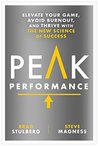
Review: Peak Performance: Elevate Your Game, Avoid Burnout, and Thrive with the New Science of Success

Peak Performance: Elevate Your Game, Avoid Burnout, and Thrive with the New Science of Success Peak Performance: Elevate Your Game, Avoid Burnout, and Thrive with the New Science of Success by Brad Stulberg
My rating: 5 of 5 stars

This book falls into one of my favorite genres, which is best described as how to be the best you can be. Peak Performance is authored by two guys, Brad and Steve, each of whom peaked rather dramatically (in business and in sports, respectively) but burned out. They met, shared beers and bios, and teamed up to write about a topic they both love – the science of performance.

What this book offers, which many others of this type do not, is pace and balance. It has the perfect combination of anecdote and science. The authors found the optimum time and space to devote to each topic. And the delivery is downright neighborly without sacrificing any of the heft one seeks in a book on best practices in productivity.

They refer to some of my very favorite authors/researchers and that made me smile: Mihaly Csikszentmihalyi, Roy Baumeister, Kelly McGonigal, Adam Grant, Daniel Kahneman, Mason Curry, Walter Mischel, Tim Noakes, Daniel Pink, Viktor Frankl …. and many, many more.

Topics discussed included the importance of balancing rest with stress for success, establishing routines for minimizing decision fatigue, failing productively (struggles give birth to skills!), and becoming a minimalist in order to get the most bang for your attention-buck. Each chapter is summarized at the end, which is not a huge thing, but I found it useful, I did.

Peak Performance is a nifty distillation of the best current human performance science in both physical and cognitive realms and I enjoyed it from start to finish. You will be reminded about your potential, and you when you finish it, you will have more resolve to chip away at the nonsense and time-wasters which keep you from meeting your goals. You will feel ready for change.


View all my reviews

Friday, December 7, 2018

Review: The Woodlanders

The Woodlanders The Woodlanders by Thomas Hardy
My rating: 4 of 5 stars

The late 19th Century teemed with Hardy’s words. He wrote heaps and it is all good. This book, The Woodlanders, was his own personal favorite.

Set in an isolated, slightly backward village known as Little Hintock, it tells the story of a bright young woman and her always "too little, too late love life", which seemed destined for tragedy due to a serious problem with timing.

This quote really sums up the infernal, ever-present puzzle in this book: “Such miserable creatures of circumstance are we all.”

Grace Melbury is the objet de désir throughout. She was sent away to boarding school because her father wanted her to rise above her circumstances. He did not want her to be a commoner, he wanted her to advance beyond the culture of their little village. She returns bright, refined, and cultured. Now, she is caught between two worlds. She loves a commoner as well as a promising, well-educated doctor (or at least she thinks she does).

Grace is a principled young woman who has great difficulty resolving the unprincipled forces in her life, constrained as she is by the intractable subjugations of women at the time. In other words, she is not really free to fix this up to her own satisfaction. Add to this general problem of emotional bondage, the interference from the world outside of Little Hintock and interference from her meddlesome father (whom she is absolutely bound to obey) and you have a perfect storm for the tragedy of unintended consequences.

Some of the players: Giles (the commoner/a woodlander) was a breath of fresh air but extremely dense at times. Edred (an outsider/doctor) needs very much to get over himself. Marty (a poor woodlander girl) made me smile; she was pure strength.

I love Hardy but I was grateful that this story was not as solidly tragic as Tess of the d’Urbervilles. I did find the plain satisfaction I typically seek at the end of a major work, but not until the end.


View all my reviews

Tuesday, December 4, 2018

Review: Bruno's Dream

Bruno's Dream Bruno's Dream by Iris Murdoch
My rating: 4 of 5 stars

As gold is to the Midas-touch, so words are to the Murdoch-touch. This writer rounds up words so keenly - beautiful constructions do result. After finishing The Sea, The Sea last month, I officially began my Murdoch bender, and, oh, it isn’t over yet. I have just acquired The Philosopher’s Pupil, but first things first. Here are my impressions of Bruno’s Dream.

The notion of a dying old man who hopes to find closure and understanding with his only living child, was deeply appealing to me. But, this old man is a scabrous thing, unlikeable and needy. Apart from his clumsy and impatient attempts to mend bridges, paucity of merit alone marks his character, and, somehow, whatever ails him (other than old age) has deformed him horribly.

The cutlery of Murdoch’s character development is devilishly good. There is no one we dearly love and no one we actually hate. There is a ball and chain fastened securely to the heart of each character. Baggage they have each lugged through life. Then, through Bruno's wish to make amends, crazy stuff begins to happen. They each go through a personal crisis which loosens each ball and chain. They change.

We can identify with each of these characters, just a little, which is what casts the spell so well. Ok, the creepy, elfin-like and puzzling Nigel is an exception. I did not like him and can’t imagine anyone who would.

It is possible that there are too many characters. It is also possible that the zany channeling of Twelfth Night-like switcheroos gets tiresome. But, with quotes like this peppering each page, I can overlook those teensy aggravations:

“Brooding about the past is so often about how one might have won and resentment that one didn’t. It is that resentment which one so often mistakes for repentance.”

You will be moved by this book.


View all my reviews